
Jump to a section
Saturated insulation usually needs to be removed and replaced, but that does not automatically mean replacing the entire roof. If the damage is confined and the surrounding materials remain sound, a local repair may preserve much of the existing assembly.
The important distinction is between stopping new water and dealing with what is already trapped. A surface patch can stop a leak while leaving saturated boards underneath. Before choosing between selective work and a complete tear-off, we need to understand the affected layers, the extent of damage and its cause.
How water reaches a flat roof assembly
Many flat roofs have a waterproof membrane above rigid boards, sometimes with a separate cover board, all supported by a structural deck. An opening at a seam, flashing or penetration can admit water into those layers. Concealed joints can spread moisture beyond the entry point, so the stain inside is not a reliable outline of the damage above.
Not every moisture problem starts with rain. Indoor air can carry water vapor through gaps into colder parts of the assembly, where condensation forms. Newly enclosed buildings and renovation work can introduce another source: moisture released by construction materials and activities. A membrane-only fix will not correct an unresolved indoor moisture source.
One useful example comes from the Polyisocyanurate Insulation Manufacturers Association: burning a 200-pound tank of propane produces about 30 gallons of water. That does not mean 30 gallons enter the roof. It explains why unvented temporary heating and other moisture-producing work belong in the investigation history, particularly when dampness begins during construction.
PIMA: moisture generated during constructionHow damaged materials insulate
Water can reduce thermal performance and damage adjacent materials. The effects depend on the products, how much water they retain and how long the exposure continues. A percentage loss quoted online is not a measurement of your property, and it cannot be converted directly into a heating-bill increase.
Rigid foam, fibrous boards and cover boards do not all behave alike. The condition of facers, joints, adhesives and fasteners matters alongside the material itself. The boards beneath a membrane need to provide a suitable base as well as thermal resistance. Materials that insulate effectively when dry can still become unsuitable after prolonged exposure. A board that dries but has lost strength or its facing is not automatically suitable to keep.
Persistent dampness can contribute to corrosion or decay in vulnerable supporting materials. It can also compromise the base needed for new membrane or coating applications. Checking the insulation below is therefore part of deciding what can remain, not simply an energy-efficiency upgrade.
When a wet roof inspection helps
Recurring stains, leakage after several patches, blistering or changes in the surface can justify closer examination. A soft spot observed by a trained contractor is another clue, but softness can also come from crushed boards or other deterioration. None of these observations establishes the complete extent on its own.
Before a roof inspection, the most useful starting point is a dated record from inside: where water appeared, the weather at the time and what changed after earlier work. Include recent HVAC visits, new penetrations and alterations to indoor heating or ventilation. Photographs taken safely from accessible locations are more useful than walking across a suspect surface.
The assessment should connect those records with exterior conditions. The absence of active roof leaks is not proof that concealed layers are dry. Equally, one ceiling stain is not proof that every part is saturated. Both assumptions can lead to the wrong expenditure.
How we assess commercial propertiesHow a moisture survey works
To detect wet insulation, a useful investigation separates three questions: where moisture may be present, which materials are affected, and how it got there. The moisture detection method must suit the assembly. The work may combine surface observations, readings across a mapped grid and selected openings, rather than treating one device as a complete answer.
Thermal imaging locates differences
Infrared scanning can reveal temperature patterns associated with retained water under suitable conditions. This use of thermal imaging helps direct attention to suspect areas rather than guessing from a ceiling stain. Changes in materials, thickness, surfacing and the weather affect the interpretation. A bright patch on an image is a suspected anomaly to investigate, not a photograph of liquid water.
ASTM C1153 addresses locating wet insulation and verifying the imaging with invasive tests. Its public description also makes an important distinction: this method does not determine the cause of moisture or its point of entry. Finding the damp zone and finding the opening that admitted water are separate tasks.
Testing to detect wet insulation
A core sample or controlled opening can establish what is actually present at that location. Record the layer sequence, observed condition and findings rather than just a single percentage. Comparison locations help interpret the readings; suitable sampling is determined by the assembly and the purpose of the investigation.
A roof moisture report should include a marked plan showing suspect zones, verification points and locations that could not be assessed. A blank space on a drawing should not quietly become an assumed dry section. A moisture survey is useful only when its findings can be connected to the actual construction. Openings also need compatible, watertight reinstatement.
Can soaked boards dry in place?
Do not plan on concealed insulation drying simply because the roof leak has stopped or a sunny week is forecast. Restrictive layers above and below can greatly limit drying. Surface dryness tells you little about material enclosed inside.
Drying behavior does vary with construction. Oak Ridge National Laboratory has studied specially designed downward-drying assemblies. That work is not a general instruction to cover damp material, add vents or wait for it to recover. A proposed drying approach needs a suitable moisture path, evidence that the products remain usable and a way to verify the result.
Wet boards that are saturated or deteriorated are removed and replaced with dry, compatible products during ordinary remedial work. If someone proposes retaining affected boards, ask how their condition will be established and how the approach meets the selected manufacturer's requirements. Waiting without a defined endpoint leaves you paying for uncertainty.
ORNL research on assembly-specific dryingWhen a local repair makes sense
Selective work can be an excellent choice when confirmed damage has a practical boundary, the entry point can be corrected and surrounding materials are suitable to retain. The existing membrane must also allow a dependable tie-in to the selected repair system. Saving sound material is useful only if the completed detail can remain watertight.
A typical sequence is to open the affected section, remove compromised layers, examine the support, correct damage and install compatible new boards and membrane. The final boundary follows verified conditions, not just the size of a stain or the original patch.
For a commercial flat roof membrane, the connection between old and new work is as important as the new material in the middle. Age, contamination, previous coatings and the ability to weld or bond the perimeter influence what is feasible.
Our approach to commercial roof repairWhen keeping the assembly stops making sense
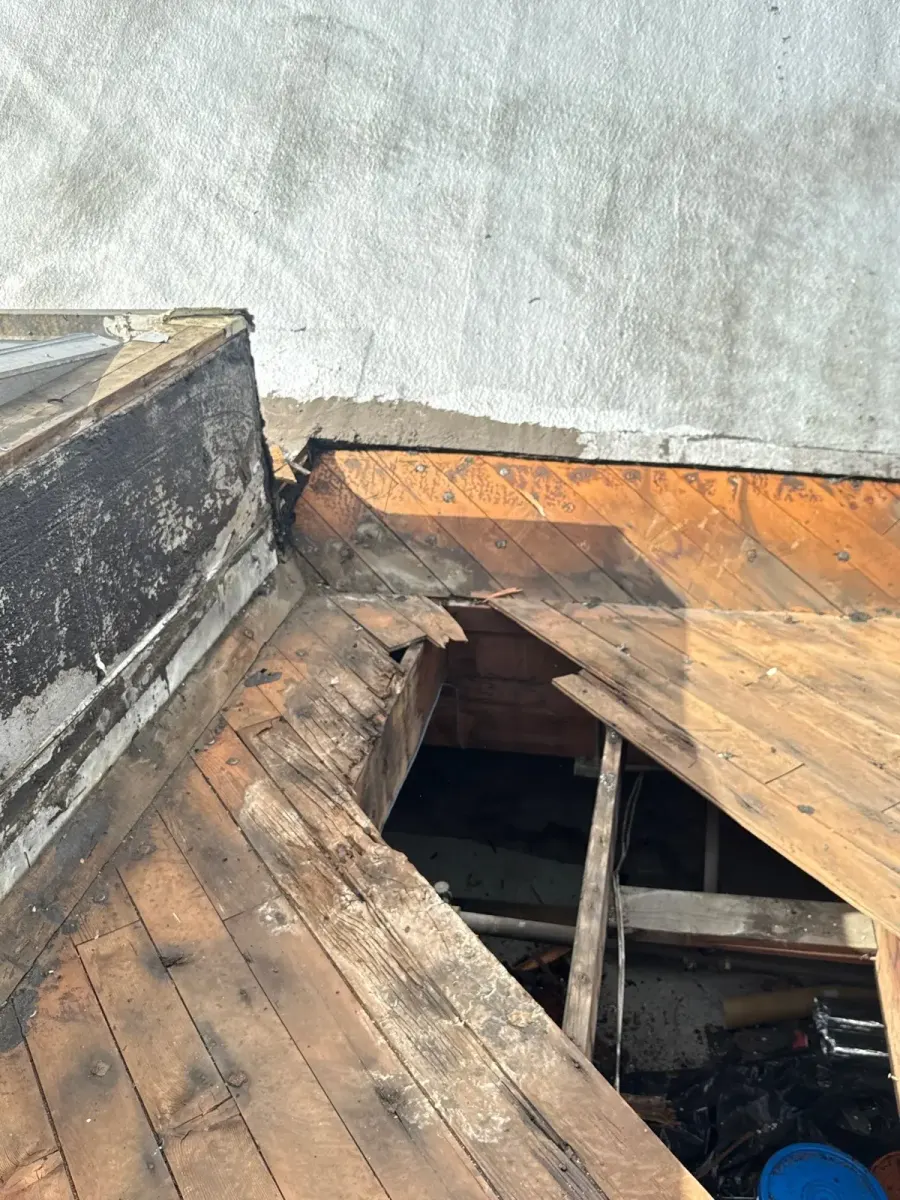
Widespread deterioration, repeated failures, compromised attachment or damaged supporting structure can make piecemeal work a poor investment. Even limited moisture can be difficult to isolate if the surrounding membrane no longer accepts reliable connections. Conversely, a sound, distinct section may be worth preserving despite more extensive work elsewhere.
Compare the work required to retain the existing materials with the work required to remove them. Include preparation, numerous transitions, concealed-damage allowances and the remaining condition after completion. The lowest initial price is not necessarily the least expensive way to keep an occupied building protected.
A complete tear-off can provide access to underlying conditions and allow the assembly to be reconsidered for drainage and thermal needs. It also adds removal, disposal and weather-protection work. The proposal should explain why that additional work is justified on this property.
On a wet roof, the distribution of damage also affects the practical choice. Several disconnected areas around equipment may involve more preparation and repeated tie-ins than one open section. Ask what the full proposal leaves in service, not only how much new material it provides.
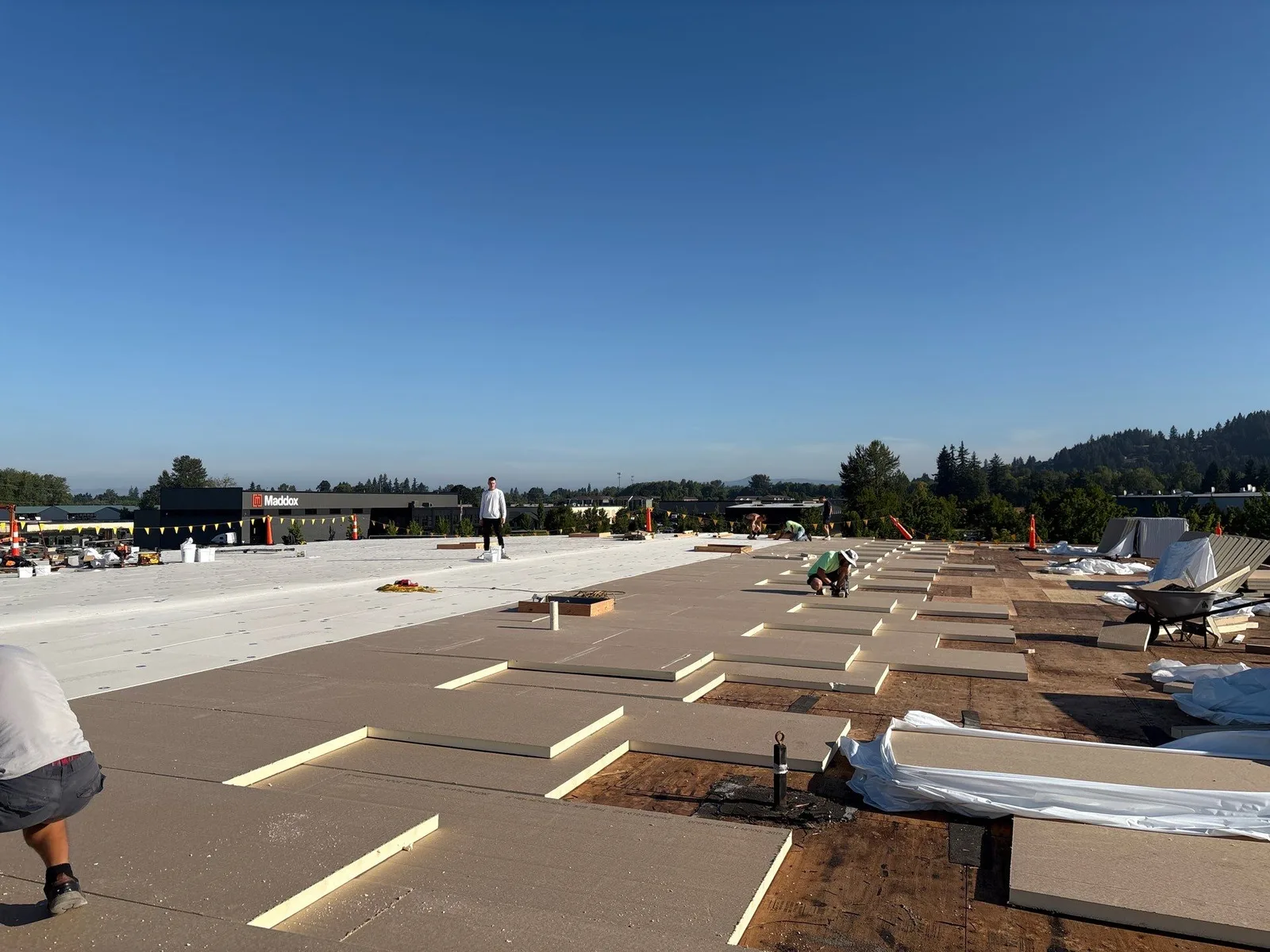
On our Portland industrial reroof, we opened the existing assembly, installed roof-board panels and fitted new membrane around the rooftop structures. The project photos follow exposed timber decking, panel installation and the completed surface around pipes and raised openings. That sequence shows why the condition of the supporting layers and their connections matters before new material goes on.
When complete roof replacement is appropriateSee our Portland industrial reroofWhy percentages need context
“Twenty percent moisture” is incomplete information. Does it mean one-fifth of the surface was flagged, a sample's water content by weight, or a relative instrument reading? These describe different things. Ask which layer was measured, what the number represents and how it was verified.
Affected-area thresholds can also belong to a particular program. For example, GAF's Liquid-Applied Roofing Manual requires a complete tear-off at 25% or more affected area for eligibility under its Liquid-Applied NDL Diamond Pledge guarantee. That is a named manufacturer's requirement in a specific context, not a universal economic cutoff or a rule for every roof.
GAF also requires removing saturated insulation before coating. Its guidance is a useful reminder that restoration starts with substrate suitability. Other products and assemblies must be assessed against their own applicable instructions; being below someone else's threshold does not establish eligibility.
GAF preparation requirements — page 18Same damaged area, very different work
Consider a simple planning example. One square measuring 20 by 20 feet covers 400 square feet, with 80 linear feet around its edge. Sixteen separate 5-by-5-foot squares cover the same 400 square feet, but have 320 linear feet of combined edge.
That is four times the boundary to address, not a prediction of four times the price. Actual tie-ins extend beyond openings, shapes are irregular, and access or nearby equipment can change the work. The example shows why a map and the arrangement of damage matter alongside total square footage.
One continuous section
20 × 20 ft · 400 sq ft
80 linear ft of boundary
Sixteen separate sections
Each 5 × 5 ft · 400 sq ft total
320 linear ft of boundary
When comparing bids, ask whether many small openings can be grouped into a practical section, what sound material that would remove and what condition would remain. A percentage alone cannot answer those questions.
What a useful proposal should include
A defined scope makes competing proposals easier to compare and reduces surprises when concealed conditions are exposed. Look for the following before authorizing work:
- A marked plan linking findings to the proposed removal boundaries, including inaccessible sections and investigation limits.
- The layers to remove and retain, with an explanation of how retained materials were judged suitable.
- Correction of the moisture source, not only installation of a new surface.
- Specified new products, thicknesses, attachment and compatible transitions to the retained membrane.
- An allowance or unit-pricing method for hidden damage, supported by photographs, measured quantities and an approval point before extra work proceeds.
- Daily weather protection, access and material-handling arrangements that account for tenants, equipment and occupied spaces.
- Completion records, the applicable written warranty terms and the future checks needed to maintain the work.
If two proposals have different totals, first check whether they are buying the same investigation and corrective work. A lower allowance is not a saving if the omitted work will simply return as an extra charge.
Questions about concealed moisture
Can a coating solve the problem?
A coating can renew a suitable prepared surface; it does not extract trapped moisture. Damaged material must be addressed first, followed by the required preparation and suitability checks. Covering the visible surface is not a substitute for investigating the layers below.
Compare renewing the surface with a complete rebuildDoes the membrane type settle the decision?
No. TPO, PVC and EPDM roofs can contain different supporting assemblies. The membrane name does not establish the condition of the boards, attachment or structural support. Match the proposed corrective method to the materials actually present, including previous coatings and patches.
Does extra foam fix damp material underneath?
Adding a new insulating layer changes heat flow, but does not by itself establish that retained materials are dry, stable or acceptable. Treat an overlay proposal as an assembly decision: what remains, how it was evaluated and why the proposed construction is suitable.
When an overlay can be consideredShould work wait until water appears inside?
No. A known breach, recurrent symptom or confirmed concealed damage deserves timely evaluation. Protect affected interior spaces and arrange an assessment. Stopping further entry and deciding what to remove can be separate stages; neither should be mistaken for completion of the other.
Plan the next step for your property
We work on commercial flat and low-slope properties across Portland, Vancouver and the I-5 corridor from Salem to Olympia. Our services include targeted repairs, coatings, overlays and complete reroofing, so the conversation can start with the condition of your property rather than a predetermined treatment.
Bring previous reports, photographs and a short history of the symptoms. We will review what is known, discuss what needs further assessment and explain the work that fits the findings. The useful outcome is a decision about what can stay, what must come out and what needs correcting before it is covered again.
Schedule my roof assessment